
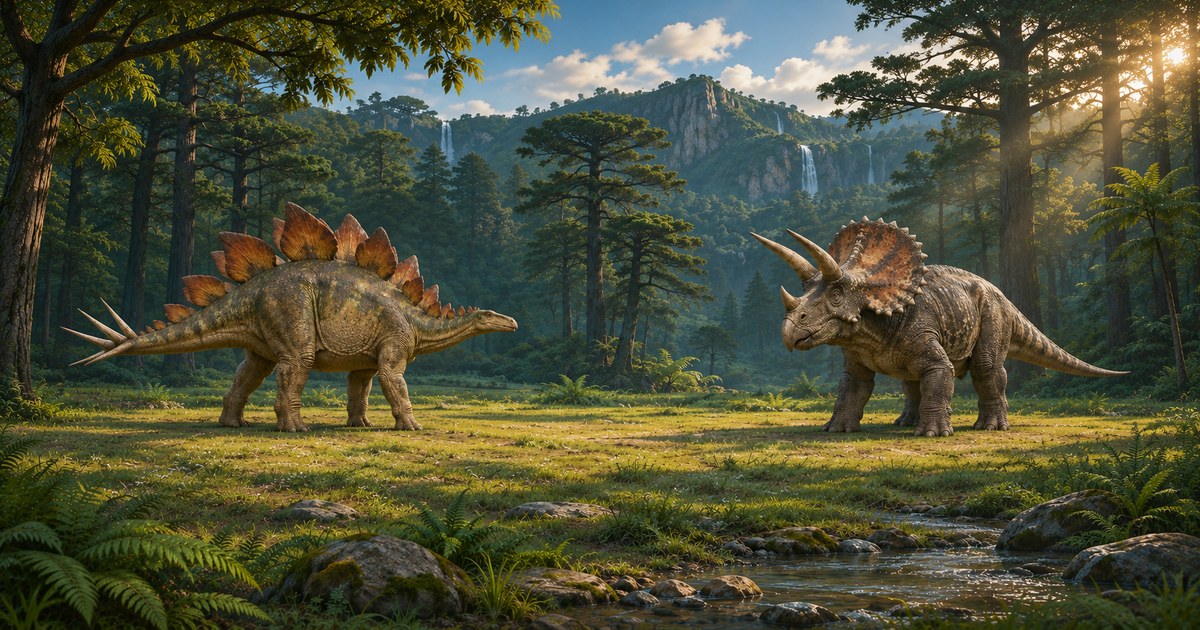
Choose Stegosaurus if you enjoy managing the space around a dangerous tail. Choose Triceratops if you prefer keeping a threat in front of your horns. Both choices reward planning, but they ask you to pay attention to different parts of your dinosaur. The better pick is the one whose positioning you want to practise through a whole session.
This comparison is about playing each herbivore in EVRIMA. It does not predict a Stego-versus-Trike duel: growth, condition, terrain and player decisions change that encounter.
Reviewed on 8 November 2026. The cover is an AI-generated conceptual illustration, not an official game model or combat screenshot. Check your installed game and current release notes for controls and balance changes.
Stegosaurus or Triceratops: the quick comparison
| Your preference | Stegosaurus | Triceratops |
|---|---|---|
| What to learn first | Where your tail can reach and how much room it needs. | How facing and turning affect your horn attacks. |
| A common positioning mistake | Watching one target while losing track of nearby bodies and obstacles. | Following a target until you have no comfortable room to turn. |
| Travelling with others | Leave deliberate space around each animal's tail. | Keep approaches and escape routes clear rather than crowding a doorway or bank. |
| A reason to choose it | You enjoy patient spacing and learning attack angles. | You enjoy managing the direction of an encounter and learning horn inputs. |
Those are practical learning priorities, not numerical rankings. Neither animal's adult appearance tells you how comfortable its younger stages will feel, or whether it suits the amount of time you have tonight.
Stegosaurus: learn the space around your tail
Stego's distinctive defensive tool is its spiked tail. The official 2024 development reports describe work on its power swing. Later, patch 0.20.117 corrected abnormal hits in front of the body. That history is a good reason to avoid treating an old combat clip as an exact reach diagram.
When practising, start with space around you. Turn the camera, notice your body orientation and check where an obstacle would limit the next movement. Looking directly at a predator does not by itself mean your tail is lined up for the action you want.
Patience here means choosing an action you understand, rather than swinging repeatedly because something is nearby. After the action, reassess your surroundings. A second animal, a juvenile companion or a rock can matter more than the opponent you were watching.
For the individual controls and a longer survival routine, read the Stegosaurus guide. Use your current bindings when practising; this comparison deliberately avoids a damage table that would suggest a certain number of hits always decides a fight.
Triceratops: keep track of facing and movement
Trike makes the direction of your head and horns an obvious starting point. The official 0.20.109 release notes introduced Triceratops and described ceratopsian flip and thrash inputs. They also explain that thrash blocks movement during the attack. Learn the difference between actions before relying on them in a crowded encounter.
Try approaching a harmless terrain reference, turning away and moving out again. If the ground makes that awkward without an opponent present, it is a poor place to discover the same limitation during a fight. Leave room beside you as well as in front.
Facing one threat is not the same as controlling every approach. Look away often enough to understand what is happening at your flanks, then return to the action you intended. Avoid following a moving target blindly into vegetation or towards a drop.
The Triceratops guide covers the input distinctions and herd habits in more detail. Neither horns nor a large body should replace checking the route you will use if you decide to leave.
Compare the journey, not just the adult
Before choosing either species, ask whether you enjoy its ordinary travel and feeding routine. A dinosaur can look ideal in an adult highlight video while feeling frustrating during the quieter parts that make up your own sessions.
Use your current food panel to decide what you need. Do not assume the same plants, growth estimate or route from another species will solve this character's needs. Plan a manageable food-and-water trip, then adjust it to your condition rather than chasing a perfect-looking destination across the island.
A younger animal also changes the pace of a group. Agree on a reachable checkpoint before moving off and check that everyone can continue. The diet guide explains the food decision; the terrain guide helps with evaluating the ground between stops.
Which should you choose with friends?
Choose a species your group wants to learn together, then agree on spacing before danger appears. Do not make the smallest animal repeatedly sprint to catch up, and do not assemble so tightly that nobody has room to act.
For Stegosaurus, deliberately discuss tail space. For Triceratops, discuss who is watching which approach and keep room to turn. These are communication habits, not prescribed formations or promises that a herd becomes safe.
If your group uses TheIsleMinimap, shared positions can help you regroup after someone opens Asset Location or copies their coordinates. They do not show an unobserved enemy or continuously follow a friend whose coordinates are hidden. A shared destination pin is a meeting reference, not a combat instruction.
A useful first-session test
- Pick one animal for its controls. Spend time learning its orientation and actions in an uncrowded place.
- Make one ordinary resource trip. Notice whether travel and feeding feel enjoyable, not only whether you survive an encounter.
- Review one awkward moment. Was the problem an unfamiliar input, cramped terrain or poor spacing?
- Try the other species for a comparison. Judge the same everyday tasks instead of comparing unrelated highlight clips.
Keep the setting consistent where possible. A calm trip with one animal and a crowded encounter with the other do not tell you much about which controls you prefer. Give yourself enough practice to separate unfamiliarity from a play style you do not enjoy.
Stego versus Trike questions
Which one wins a fight?
There is no dependable answer from species names alone. This guide helps you choose what to play, rather than promising a duel result.
Is either one automatically easy for a beginner?
No. Learn resource travel and turning space alongside attacks. Familiar terrain can make learning either animal less confusing.
Should I use a Legacy combat guide?
Use EVRIMA instructions for EVRIMA and confirm your current bindings. Similar names do not establish identical mechanics across branches.