
Looking for a The Isle T-Rex guide? Tyrannosaurus in EVRIMA is more than a large bite. Learning Crush, muzzle swings and Ambush helps you understand its attacks, but staying alive also means choosing sensible journeys and keeping your juvenile out of fights it cannot afford.
This guide covers The Isle EVRIMA Tyrannosaurus, not Legacy Rex. The controls below are anchored to released patch notes; your current bindings and game prompts take priority. The four AI-generated illustrations are teaching concepts, not official screenshots, exact attack animations or real Gateway geography.
T-Rex controls in The Isle EVRIMA
The official patch 0.21.321 release notes introduced Tyrannosaurus and describe these ability inputs:
- LMB: standard bite; the notes also describe directional primary attacks
- RMB: light muzzle swing
- Hold RMB: heavy muzzle swing
- Hold LMB: Crush, a lunging bite that can inflict fractures; its outcome depends on the target
- Spacebar, from subadult: Ambush, a temporary sprint boost followed by a cooldown
- RMB after crushing a target: Throw, a finishing action described for an already-held target
Practise distinguishing taps from held inputs before a fight. Holding the normal bite button is not the same decision as making one quick bite. Start with clear space in front of you and watch how far your animal moves, where its head finishes and when normal movement resumes. Do not use a crowded feeding spot as your first control test.
For directional attacks, compare your current control settings and prompts rather than assuming every older video uses your configuration. Check again after changing bindings. An attack that works in open space can still be a poor choice beside a rock, bank or another animal blocking the way.
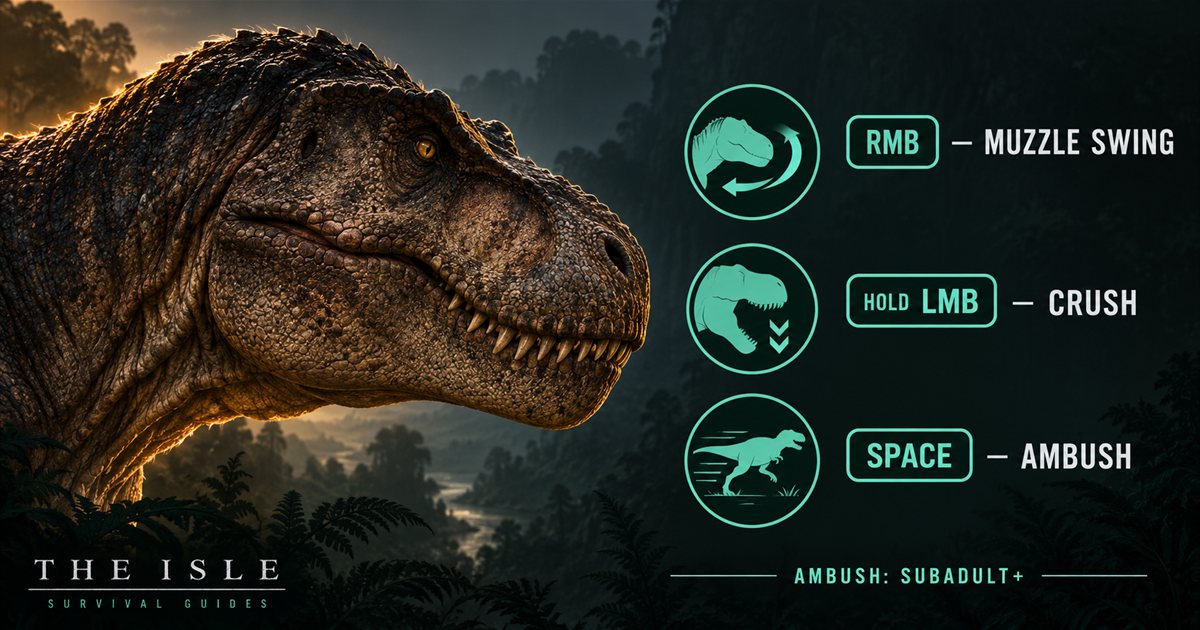
Using Ambush and choosing a T-Rex hunt
Use Ambush as part of an approach you have already considered, not as a reason to chase everything in sight. Before committing, look beyond the target: where will you finish if it turns away, and what will you do if the first attack misses?
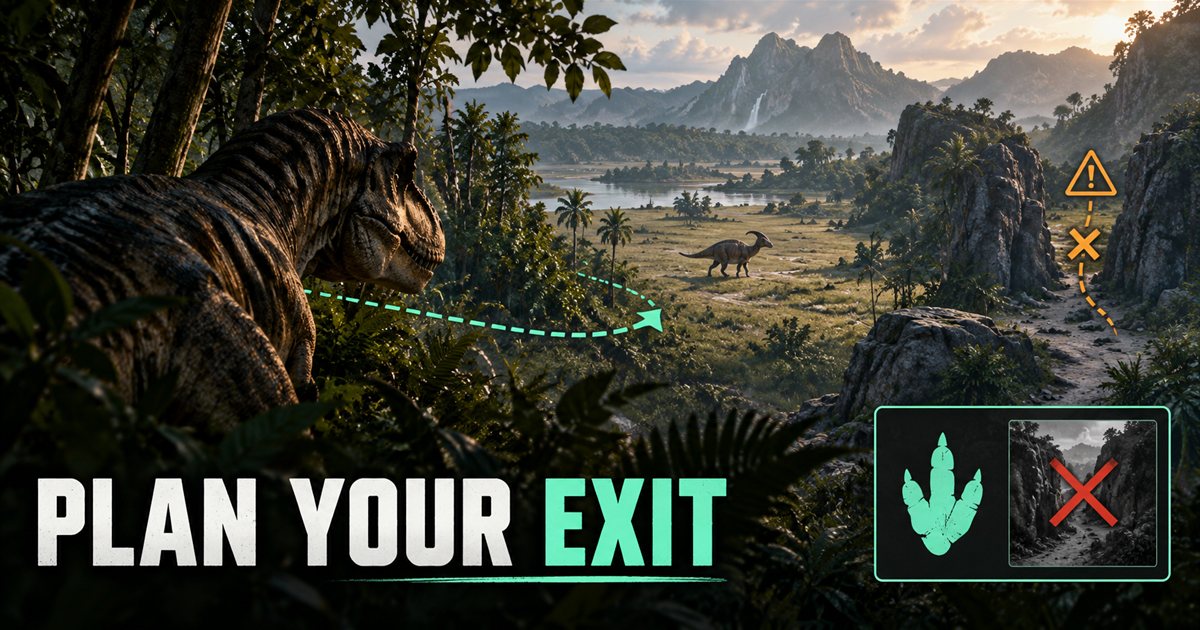
A useful hunting checklist is target, terrain, resources, exit. Is the target alone? Is there enough room to move? Are hunger and stamina forcing a rushed choice? Does the approach leave somewhere to go afterward? None of those questions is answered simply by being a large dinosaur.
Consider a prey animal standing near a narrow gap. You may be able to reach it, but committing into the gap can leave very little room to change direction. Observing from a forest edge and waiting for a clearer opening gives you more options. It does not make concealment perfect or guarantee a successful ambush.
Against another large animal, avoid treating one successful attack as the end of the encounter. Watch its response and your own position. If the situation changes, disengaging or declining the hunt can be a better survival decision than continuing because you expected an easy meal.
How to grow a juvenile Tyrannosaurus
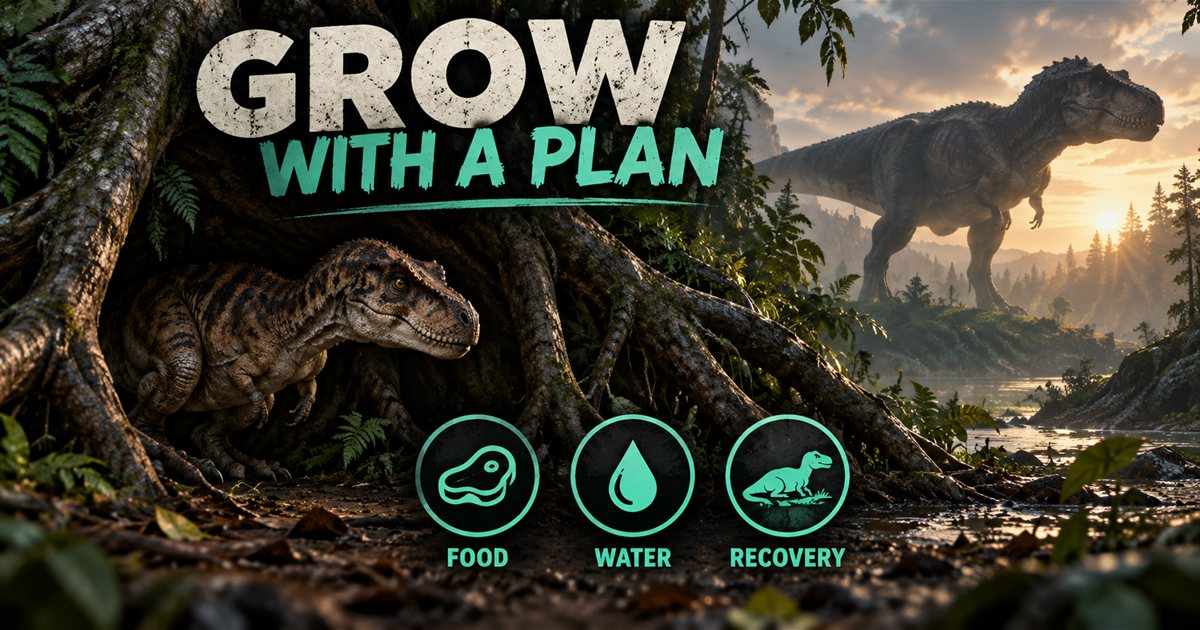
Your first objective is a repeatable food-and-water routine, not an adult-style fight. Refresh your location, choose one realistic resource destination and learn a nearby landmark you can recognise on the return. A smaller familiar loop is easier to reassess than a long journey into unknown terrain.
Keep checking your animal's current life stage. Do not plan around Ambush before the subadult requirement described in the release notes. Likewise, an adult tutorial's reach and encounter outcome should not be treated as a juvenile matchup guide.
When food is found, observe before feeding. Nearby calls, movement or an exposed approach may make the meal more costly than it appears. If you cannot reasonably contest it, finding another option is not wasted growth time; it can prevent the loss of the entire run.
There is no fixed growth-time promise here. Your live growth and diet panels are more useful than a timer copied from a different patch or server configuration. Read our EVRIMA growth guide for broader progression advice, and keep resource planning separate from claims that a location is permanently safe.
T-Rex diet: food before an unnecessary fight
Open the Status Report and read the preferred foods shown for your current animal. Decide which nutrient needs attention before travelling for a meal. Filling hunger and meeting a particular diet need are not automatically the same thing.
After eating, check the actual result. If the nutrient you wanted is still low, reconsider the next destination rather than repeating the same journey without looking at the panel. Our food and diet guide explains that broader resource loop.
A visible body is not necessarily unclaimed, and an animal-location reference is not a confirmed live food spawn. Avoid building your whole route around a single expected meal. Keep an alternative in mind, especially when hunger is already becoming urgent. See the AI spawns guide for the distinction between reference locations and live prey.
If you already have enough food to travel, extending an encounter just to defend every remaining bite may add risk without solving a current need. Compare what you would gain with the water or recovery trip you still need to make.
Gateway navigation for a large carnivore
Look at terrain as well as map distance. A direct line can hide a steep descent, awkward passage or river crossing. Choose a route you can actually follow with your current animal, and identify alternatives before reaching a bottleneck.
Plan water before thirst becomes urgent. Size does not make every riverbank safe. Observe the approach, leave space to turn away and avoid assuming that a quiet surface is an empty river. The Gateway water guide and Deinosuchus guide provide context, not live predator warnings.
Using TheIsleMinimap while playing T-Rex
Use map layers for location names and relevant resource references. Update your marker by copying Asset Location in-game or using the enabled screen reader with your approved area while Lat and Long are visible. The marker represents your latest accepted reading, not continuous tracking while the coordinate panel is hidden. Our coordinate guide covers setup.
Private app squads support up to four players on Squad plans. They are separate from The Isle's in-game group limits and server rules. Solo Lifetime is the solo option; use the current pricing page to compare plans.
T-Rex questions
Is Tyrannosaurus available in EVRIMA, or only Legacy?
The public EVRIMA release notes for patch 0.21.321 include Tyrannosaurus. Check your selected Steam branch and current server roster rather than following a Legacy tutorial.
Why does Space not activate Ambush on my juvenile?
The released ability reference places Ambush at subadult and later. Verify your growth stage, current bindings and ability state.
Can a T-Rex win every fight?
No. Position, condition, life stage, terrain and other players' decisions matter. Compare the Triceratops guide for a defensive perspective instead of assuming a universal winning matchup.
Where should I find food as Rex?
Read your current preferred-food panel and resource clues, then plan from your actual position. No guide or minimap marker guarantees that live prey or an uncontested carcass will be waiting.