
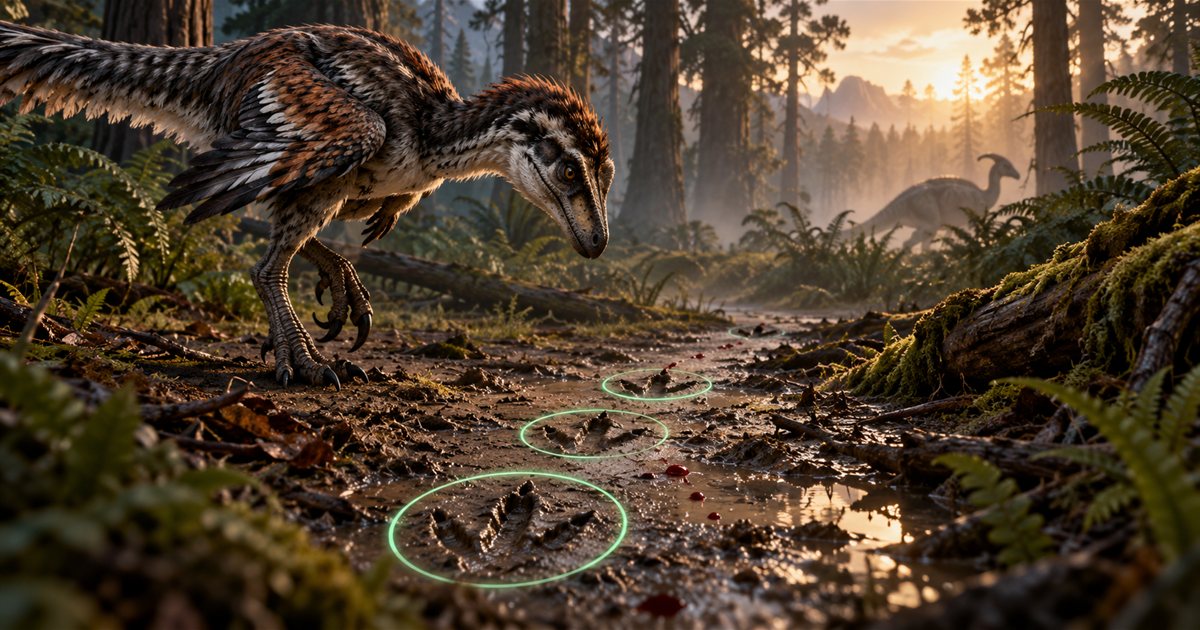
A footprint is a useful discovery, but it is not the animal itself. In The Isle EVRIMA, a good tracking attempt connects several clues while leaving you enough attention and stamina to react to what is happening now. This guide follows that process from the first mark to the decision to continue, change direction or leave.
Check your surroundings, locate more than one clear mark, establish a direction from the sequence and advance to the next confirmed section. If the evidence breaks down, return to the last clear point and search nearby. Stop when the pursuit costs more than your condition or escape options allow.
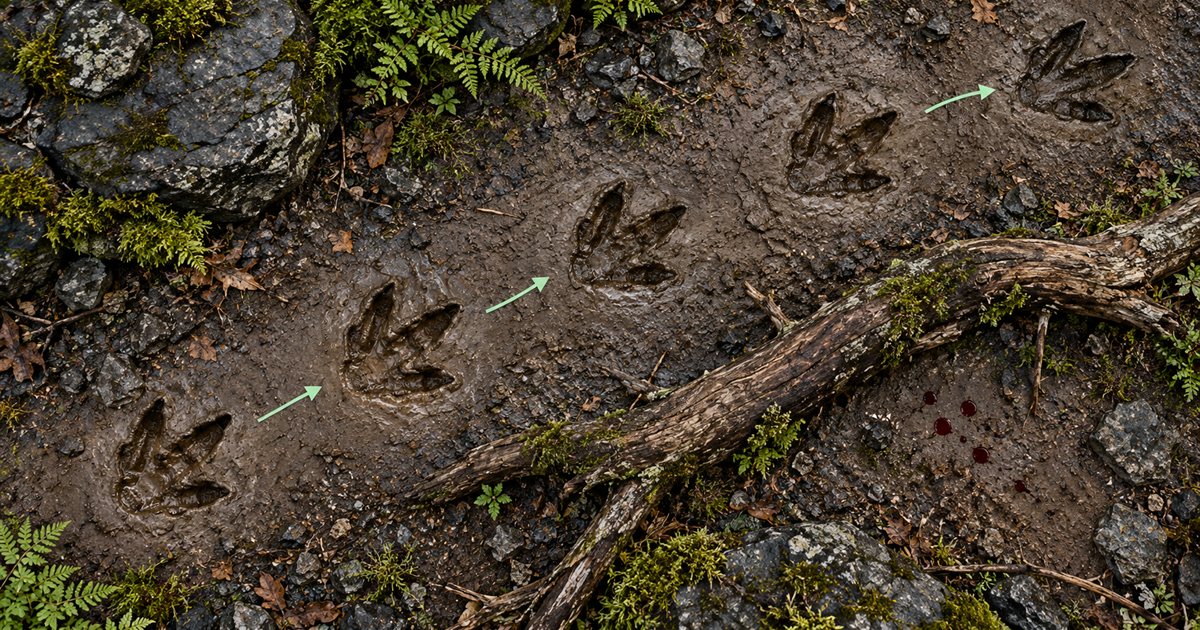
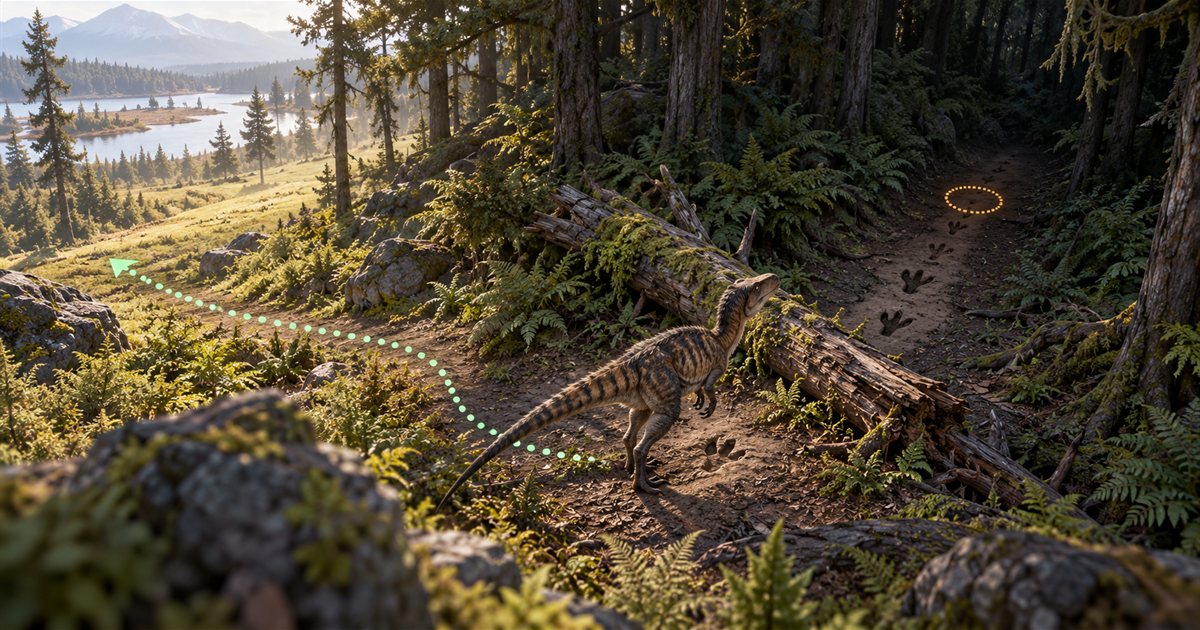
The three AI-generated illustrations explain tracking decisions. Their mint arrows, footprints and habitats are conceptual, not game screenshots, exact Gateway terrain or a live trail display.
Separate the clue from the conclusion
The first question is what you have actually found. A footprint sequence suggests earlier movement through a place. Blood is another sign to investigate. Neither gives you an exact current position, a guaranteed species identification or a reliable measurement of the animal's remaining condition.
| Evidence | Useful next step | Conclusion to avoid |
|---|---|---|
| Several footprints | Compare their orientation and where the sequence continues. | The animal must still be directly ahead. |
| Blood near a trail | Look for further drops and nearby activity. | The target is one hit from dying. |
| Multiple crossing trails | Follow one consistent sequence through the junction. | Every mark belongs to the same dinosaur. |
| Sounds or movement nearby | Look up and assess the present scene. | Only the ground trail matters. |
| A trail ending near cover | Check the last clear point and possible nearby continuations. | The animal vanished or logged out. |
This distinction keeps a search manageable. If you treat every uncertainty as proof that the prey is just beyond the next bush, you can spend an entire stamina reserve chasing a story rather than following evidence.
Check the scent and tracking controls for your build
The official December 2021 release notes introduced carnivore scent tracking from footprints and blood. They described using Q on tracks and a passive-scent toggle. Those are historical control descriptions: check your present Controls menu and playable before expecting an old key or effect to behave identically.
Start from a trace you can already inspect. Use the relevant bound scent action and observe the response, rather than trying a long sequence of shortcuts copied from an old video. Our scent guide covers the broader compass and resource workflow; this article concentrates on following a trail after finding one.
If nothing responds, separate an input problem from a missing trail. Confirm the binding, the game window's focus and what is actually on the ground. A failed attempt at one location is not enough to establish that tracking is broken across the server.
Read a sequence instead of one footprint
- Identify a clear starting point. Choose a mark you can recognize again, ideally beside a distinctive rock, branch or terrain edge.
- Locate the next few marks. Compare their placement and orientation before choosing your heading.
- Advance in short sections. Keep the last confirmed portion in mind while looking for the continuation.
- Recheck at turns. A trail bending around a tree is more useful than the direction you initially guessed.
- Look away from the ground regularly. Other animals can approach while you are concentrating on the marks.
At a junction, take the extra moment to connect the sequence through the crossing. Similar-looking marks can belong to different passages. Where the evidence is ambiguous, keep that uncertainty in your decision instead of assigning a definite target and direction.
Blood trails are clues, not a health meter
Follow the distribution of drops without turning it into a damage calculation. You may not know what caused the blood, whether several animals passed through the area or what happened after the last visible mark. A wounded dinosaur can still be dangerous, and a trail can lead toward another fight.
When footprints and blood diverge, pause rather than forcing them into one route. Check whether you have followed a different sequence or overlooked a turn. If a body or another animal becomes visible, switch your attention to that present situation. Continuing to stare at the trail after finding its possible source defeats the purpose of tracking.
If you are the injured player, use the bleeding and recovery guide. Recovering blood, managing an injury and finding cover are separate decisions from guessing how much damage an attacker believes you have taken.
What to do when footprints disappear
Stop at the last confirmed section. Note its direction, search the immediate continuation and check nearby bends or obstacles. A short, deliberate sweep is easier to recover from than sprinting far ahead and then trying to remember where the trail ended.
Terrain, overlapping activity, visibility and the lifetime of traces can all complicate interpretation. The official January 2024 patch archive records a change to footprint despawn time. It is evidence that the system has been adjusted, not a current universal timer for judging every print's age.
Do not assume a blank patch proves a particular escape trick. If you cannot reconnect the evidence after a bounded search, acknowledge that the trail is lost. Return to a known route or another food opportunity while you still have options.
Decide when the chase is no longer worthwhile
Before extending a pursuit, check your condition, the terrain ahead and the distance back to somewhere you understand. A plausible trail across an exposed slope can be a worse choice than a less exciting food search near familiar ground.
- Leave enough stamina for a response to a new encounter.
- Reconsider when hunger or thirst becomes the more urgent problem.
- Stop using an old trail to justify entering an area you cannot assess.
- Change plans when the target's route becomes unclear or the surroundings become busy.
These are planning suggestions, not hidden game formulas. The stamina guide helps you budget movement, while the AI food guide offers another way to think about finding a meal.
Avoid confusing your own group's search
Agree which sequence you are following and where the last clear mark was found. If everyone runs through the same patch and calls a different direction, communication becomes harder precisely when you need it to be simple. One person can inspect the continuation while others watch the surroundings from positions they can describe.
Keep regrouping instructions concrete: use a visible landmark or a shared destination, and say when you are abandoning the trail. Follow the server's grouping rules; coordinating outside the game does not exempt your group from them.
When you think another player is following you
Breaking immediate contact is only the first part of leaving an encounter. Consider the route you are leaving behind, your remaining movement resources and whether you can observe anyone approaching. Hiding in vegetation does not erase your previous journey.
Our mud pits and wallowing guide explains how to assess a wallow without treating a mud coating as invisibility. Avoid turning the search for a distant pit into a longer, more exposed escape than your condition supports.
Use TheIsleMinimap for your position and route
Refresh your own marker from copied Asset Location coordinates or an enabled reading mode, then compare the trail's general heading with recognizable terrain. The app's movement trail records your accepted position updates; it is not the prey's footprint trail.
Private squads can share the latest positions supplied by up to four participants. TheIsleMinimap does not detect enemy players, read footprints or blood, or reveal the animal that made a trail. Use the coordinates guide if your own marker needs setting up.
Tracking: quick answers
Can one footprint identify exactly where a player is?
No. It is evidence of a past passage. Look for a sequence and keep checking the present scene.
How old are the tracks?
Do not assign an exact age from an old guide's timer. Trace behavior has changed between builds, and this article does not promise a universal lifetime.
Does a blood trail mean an easy kill?
No. You do not know the full encounter history or the animal's current condition. Assess the animal and surroundings when you find them.
What if I lose the trail?
Return to the last clear point, make a limited nearby search and leave if you cannot reconnect the sequence without spending resources you need.