
When Gateway becomes difficult to see, reduce the size of the next decision. Choose the next piece of ground you can inspect, the next landmark you can recognise and the next place you can stop. Continuing the original long route at full speed is rarely a useful way to learn what changed around you.
This The Isle EVRIMA weather guide focuses on rain, storms and poor-visibility travel. The three AI-generated illustrations are conceptual examples, not game screenshots, weather forecasts or exact Gateway routes. The advice is about navigation and observation; it does not promise shelter bonuses, immunity or a fixed storm duration.
Check what your current EVRIMA build actually shows
Weather presentation can change between updates. The official 0.21.720 public patch announcement temporarily removed rain particles while stating weather remained functional. That historical example matters when comparing a video with your own session: the visible effect and the underlying weather state are not always identical.
Look at the conditions you can observe now. Can you distinguish the next slope, the bank and the nearby vegetation? Can you see the landmark you intended to use? If the answer changes, revise the route from those observations. Do not wait for the screen to reproduce someone else's rain animation before acknowledging poor visibility.
Night and bad weather can make orientation difficult in different ways. Check your current night-vision binding and the actual result, but do not expect it to make every surface readable. Our night vision guide covers that separately. Neither a brightened image nor a map marker confirms the ground directly ahead is traversable.
Before a storm journey: food, water, rest and one destination
Read your resource bars before starting a long trip. Identify the urgent need instead of combining every possible objective into one journey. A food route, a water visit and a distant rendezvous may require different decisions. Pick the first useful destination and retain an option to stop early.
Check the familiar part of the route while you can still see it. Remember a distinctive rock, a forest edge or a clearly recognisable crossing approach. Choose landmarks you can describe, rather than a tree that resembles every other tree around it. A useful reference gives you something concrete to compare after a turn.
Keep enough attention on stamina to revise the journey. If you spend the entire approach sprinting, the point where visibility becomes difficult may also be the point where you need rest. Our stamina guide explains travel and stopping decisions without claiming one recovery time for every animal and condition.
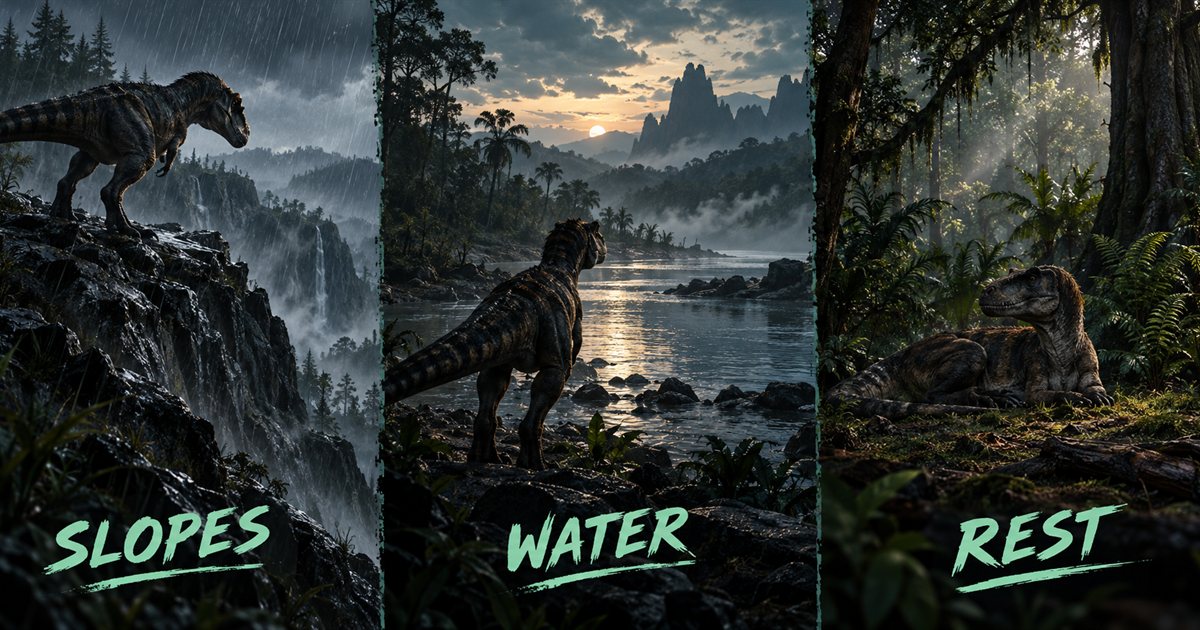
Slopes and water: inspect the approach, not only the destination
A distant location label does not explain the terrain between you and it. When the ground is difficult to read, inspect the next slope before committing. A detour over ground you understand may be easier to manage than continuing straight toward a close-looking destination.
The public 0.21.734 notes enabled hill sliding and slowdown. This is a reason to learn current slope behaviour in your own build, not a claim that rain automatically causes a separate slipping penalty. Distinguish terrain mechanics from weather effects instead of attributing every awkward movement to the storm.
At water, identify the approach and the way out. The minimap's reference can help you locate the resource, but the bank and nearby activity still need an in-game assessment. If you cannot explain where you will stand or how you will leave, inspect another approach. Our water guide develops that process.
When should you stop travelling in poor visibility?
Pause when you can no longer describe the next manageable section of the journey. First inspect the immediate area, including the ground behind you and any nearby movement. Choose a stopping point that fits what you actually see. Standing still at the first obstacle is not automatically better than returning a short distance to familiar ground.
Recheck resources before deciding to wait. If a need is urgent, a shorter journey to an inspected nearby resource may make more sense than waiting without a plan. If the objective is optional, postpone it. This is a decision about your current situation, not a universal rule that every storm should be waited out.
Cover can interrupt your own sightlines as well as another animal's. Look for a place where you can observe an approach and leave without forcing yourself into a narrow corner. Do not assume trees grant a game-defined weather resistance or that being out of sight proves no one noticed your arrival.
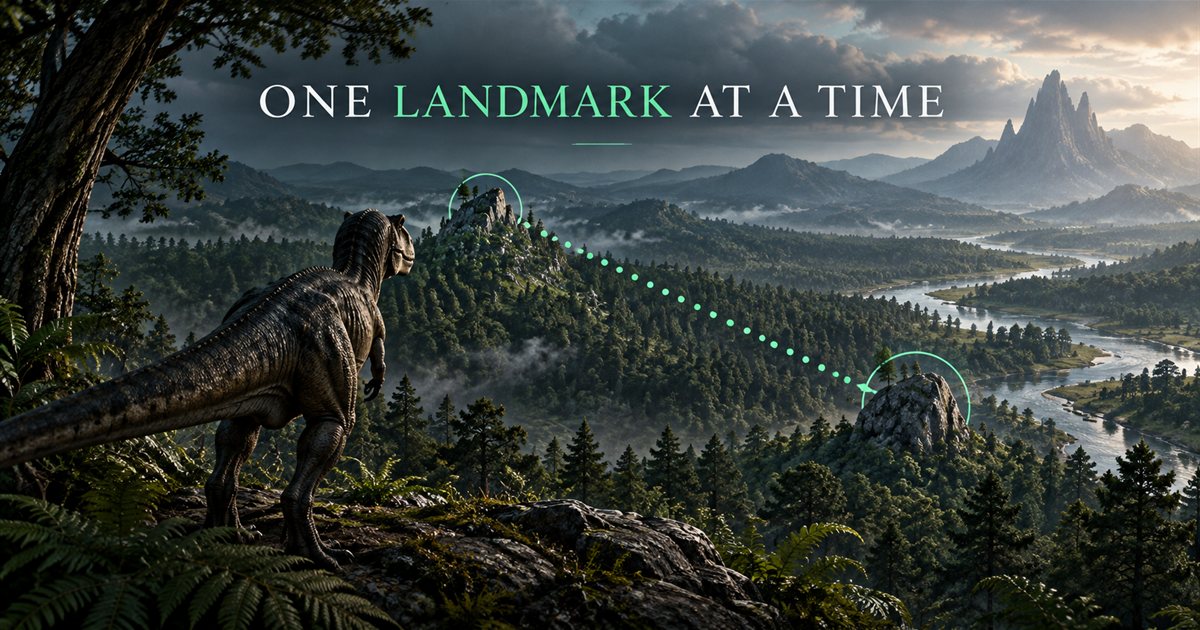
Navigate one landmark at a time
Choose a visible reference close enough to verify. Move toward it, check the ground as you approach and pause before choosing another. This makes a wrong turn easier to recognise while the previous reference is still nearby. It also gives you a natural moment to inspect resources and activity.
If you lose orientation, stop adding distance. Compare the last landmark, the direction you travelled and your latest accepted position. Work backward only over ground you can still assess. A straight-line shortcut across unknown terrain is not a reliable correction simply because it points toward the intended destination.
Keep the map readable by enabling only layers relevant to the trip. Resource and location references can answer where to investigate next; too many simultaneous markers make that comparison harder. Use the live terrain to decide how to approach the selected reference.
Regroup during bad weather using a reachable landmark
Agree on one place both players can identify and reach. Describe the side of the landmark and whether you are on land or beside water. Avoid a moving rendezvous where everyone repeatedly changes direction in response to the other's last message.
Update your position when the game's Lat and Long are visible, and say when you are stopping. A friend's marker represents their latest accepted update, which may no longer match their exact position after they move. Confirm the final approach through the game and your normal communication rather than sprinting toward a dot.
Follow server rules and the game's grouping requirements. A private app squad helps approved friends share positions; it does not change which species can group in the game or make an unfamiliar animal friendly.
What TheIsleMinimap helps with during rain and storms
The app helps you compare your accepted position with Gateway map references. Copy Asset Location or use approved local reading while Lat and Long are visible. It does not keep reading your position while the coordinate panel is hidden.
It does not forecast weather, clear rain, brighten the game, inspect slopes, reveal hidden enemies or read resource bars. Solo Lifetime provides local navigation; Squad plans add a private app group for up to four players. Use these references alongside what you can actually see.
For an evening session, pair this article with the calls and sounds guide. Listening is another source of information, but uncertain sounds should prompt observation rather than an assumption about a precise threat location.
EVRIMA weather questions
How long does a storm last?
This guide gives no fixed timer. Observe current conditions and your resources rather than planning around an unverified duration.
Does the minimap display live weather?
No. It provides map references and accepted coordinate updates, not weather forecasting.
Does standing beneath a tree guarantee protection?
No. Choose a stopping point from terrain, visibility and current activity. This guide does not claim a tree grants a weather immunity mechanic.