
Playing Diabloceratops in The Isle EVRIMA? Your horns are only part of the decision. Learn how your movement and attack inputs fit together, then give yourself enough room to stop an exchange. A defensive animal can still end up in a poor position when it follows an opponent away from its companions.
This guide focuses on Diablo controls, sparring practice, resource planning and travelling with a herd on Gateway. The three AI-generated illustrations are conceptual teaching scenes, not official screenshots, exact animations or measured terrain. Check your current game bindings and Status Report before using an older control or food reference.
Diabloceratops controls: separate movement from attacks
The community Diablo reference lists the inputs below. Its site carries an outdated-information notice, so use these as a practice checklist and confirm their behaviour in your build.
| Reference input | Action | Practice focus |
|---|---|---|
| LMB | Headbutt | Learn the ordinary attack before adding movement. |
| LMB while running | Running shove / attack | Observe your position after contact. |
| Hold RMB | Strafe mode | Compare facing and movement with ordinary travel. |
| Ctrl | Spar mode | Learn the stance with a willing practice partner. |
Choose open ground with a visible landmark. Walk, turn, stop and repeat one input at a time. Then check whether your camera direction changes the action you see. This helps distinguish an input problem from an unfamiliar animation or a movement decision made too late.
The official June 2025 patch notes include faster Diablo thrashing and a restriction on repeated ceratopsian sprinting flips. They show why old combo demonstrations should be checked against the current public build; they do not establish today's exact damage or recovery values.
Practising sparring without losing the purpose of the session
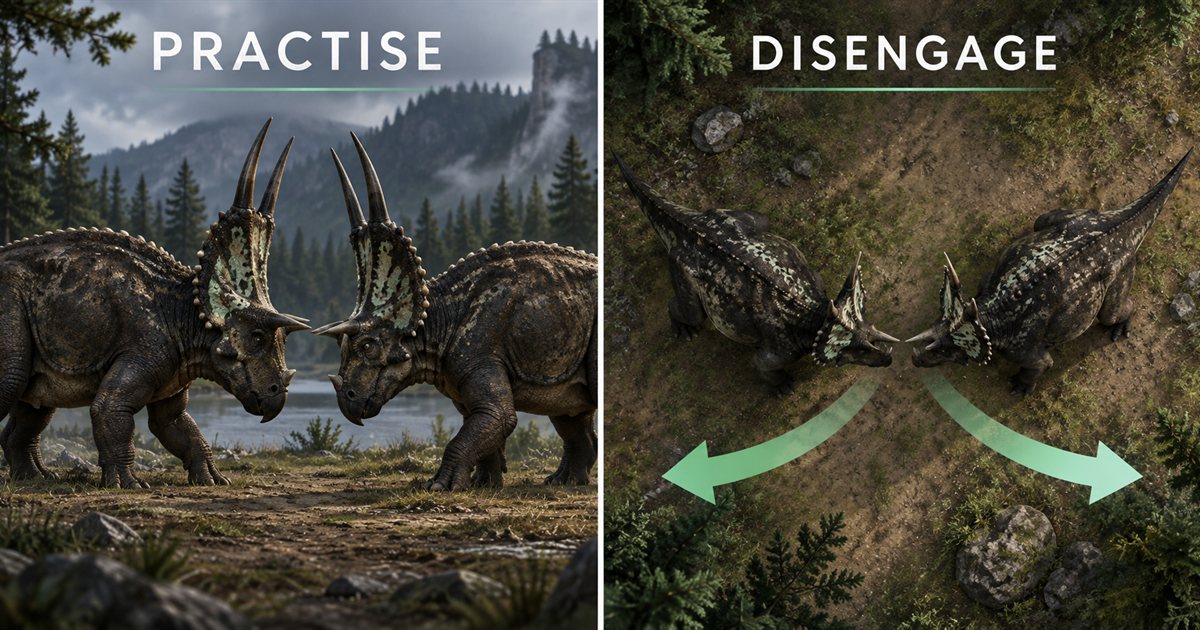
Agree with a companion that you are practising, and follow the server's rules. Begin with animals in a suitable condition, away from a cliff, deep water or a busy food patch. Decide beforehand when to stop. A practice exchange should answer a small question, such as how to change direction or disengage, rather than becoming an endurance contest.
First observe entry into the interaction. Next, compare what happens when one player moves while the other pauses. Finally, work on leaving it. Keep those experiments separate so you can tell which input changed the result. If your partner is much smaller or already injured, do not treat the encounter as a fair comparison of adult controls.
Watch your on-screen action and stamina indicators between attempts. If an action is unavailable or the response changes, pause instead of rapidly repeating buttons. Explain what you saw to the other player before restarting. Network conditions and the current balance can make a copied sequence feel different from a recorded example.
Defensive positioning: face the problem, keep another choice
Before feeding or resting, look beyond the animal directly in front of you. Another approach may matter more than the opponent attracting your attention. Keep enough space to turn and assess a different direction. Parking tightly between rocks or companions can make every response harder.
A useful defensive decision might create distance or let the herd move away together. It does not have to end in a chase. If the threat retreats toward unfamiliar terrain, ask what following would accomplish. You may be leaving the juvenile, the food source or your original departure route behind.
Consider a group resting beside a narrow passage. If every Diablo crowds into its entrance, the group may struggle to turn when something appears from another side. Moving the rest point onto ground with more room can improve your options before an encounter starts. This is practical positioning advice, not a guaranteed defensive formation or a species matchup chart.
For injuries and recovery decisions, use our bleeding, healing and fracture guide. Check what your own animal can do after an injury before attempting a long retreat.
Diablo diet: choose a resource trip from the current panel
Read the preferred foods and nutrient bars in your current Status Report. Identify the resource you need before travelling. Filling hunger with the nearest food and improving an incomplete diet are different objectives, and the next useful trip depends on the bars you actually see.
Compare that objective with water, recovery and the group's condition. A distant food reference is less useful if reaching it exhausts the least prepared member. After feeding, check the result and decide whether to stay, change resources or return to a familiar stopping point.
Use our food and diet guide for the broader system. Read the migration, patrol and sanctuary guide before treating different zone symbols as interchangeable. A mapped reference is not a promise that food is currently present or uncontested.
Herd travel: plan around the player who needs the most help
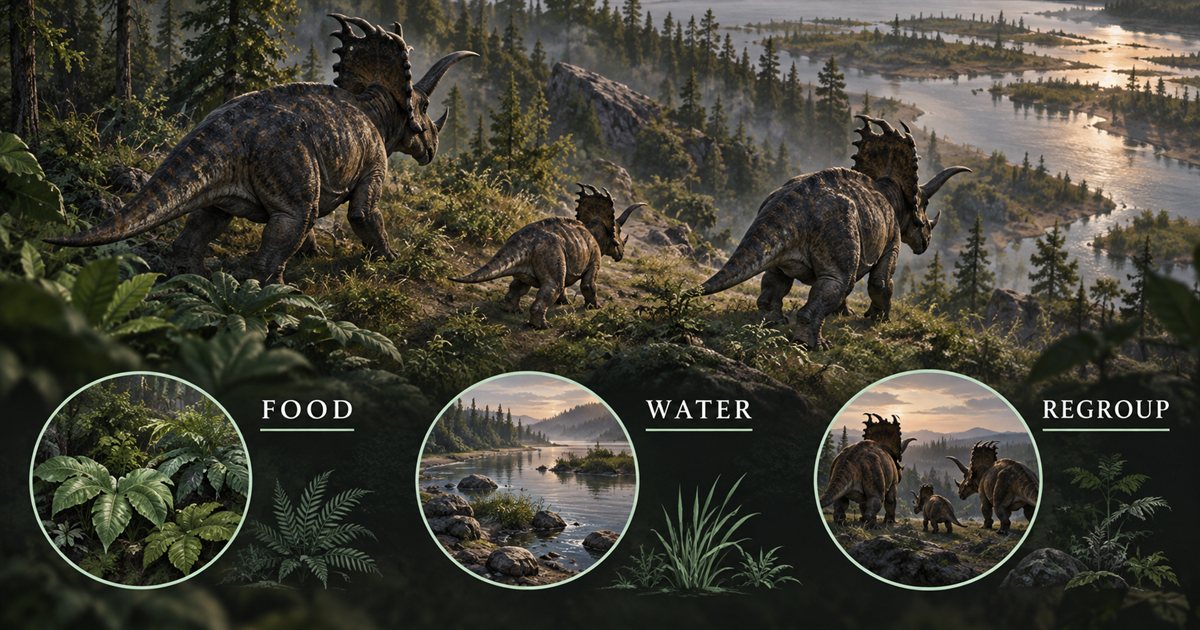
Choose a specific next stop and state its purpose: drinking, feeding or regrouping. Ask whether everyone can comfortably reach it. A route suitable for a healthy adult may be an awkward commitment for an injured or younger companion.
Keep space between animals so a direction change does not become a traffic jam. If someone falls behind, stop extending the journey and agree where to reunite. Refresh positions before choosing who moves; an old marker can send both players searching in different directions.
At water, avoid letting the whole group crowd one approach without looking around. A quiet surface does not prove that it is empty. Read our water guide and keep a manageable way to leave. A companion's arrival is useful information, but it is not evidence that the area is safe.
Growing a juvenile Diablo: avoid adult-sized commitments
Learn one resource loop before crossing several unfamiliar regions. Remember a landmark on the outward trip and another on the return. If danger interrupts the plan, those references give you a concrete place to discuss with companions.
Do not turn adult sparring footage into a juvenile combat routine. Your current movement, condition and available responses should guide the decision. Avoiding an uncertain encounter can preserve progress while you learn the animal. Our growth guide covers progression without relying on one fixed timer.
Using TheIsleMinimap for Diablo rendezvous decisions
Use location names and relevant resource references in Map Layers, then inspect the actual terrain before moving. Copy in-game Asset Location, or use approved local screen reading while Lat and Long are visible. Your marker shows the latest accepted coordinate update, rather than continuous movement while the panel is hidden.
Squad plans add private app squads for up to four players; Solo Lifetime provides local navigation. App squads are separate from The Isle's in-game group limits and server rules. The app does not read sparring state, diet, injuries or stamina, detect hidden enemies, or perform attacks.
For a different herbivore play style, compare our Dryosaurus evasion guide and Hypsilophodon movement guide.
Diabloceratops questions
Does a running attack always knock another dinosaur down?
No guaranteed result is assumed here. Check current behaviour and the actual animals involved rather than planning from an old weight threshold.
Is an app squad the same as an in-game herd?
No. The private navigation group has its own four-player capacity. It does not change game grouping limits, server rules or combat interactions.
What should I practise first?
Ordinary movement and a single attack, then entry and departure from sparring with a willing partner. Learn one change at a time.