
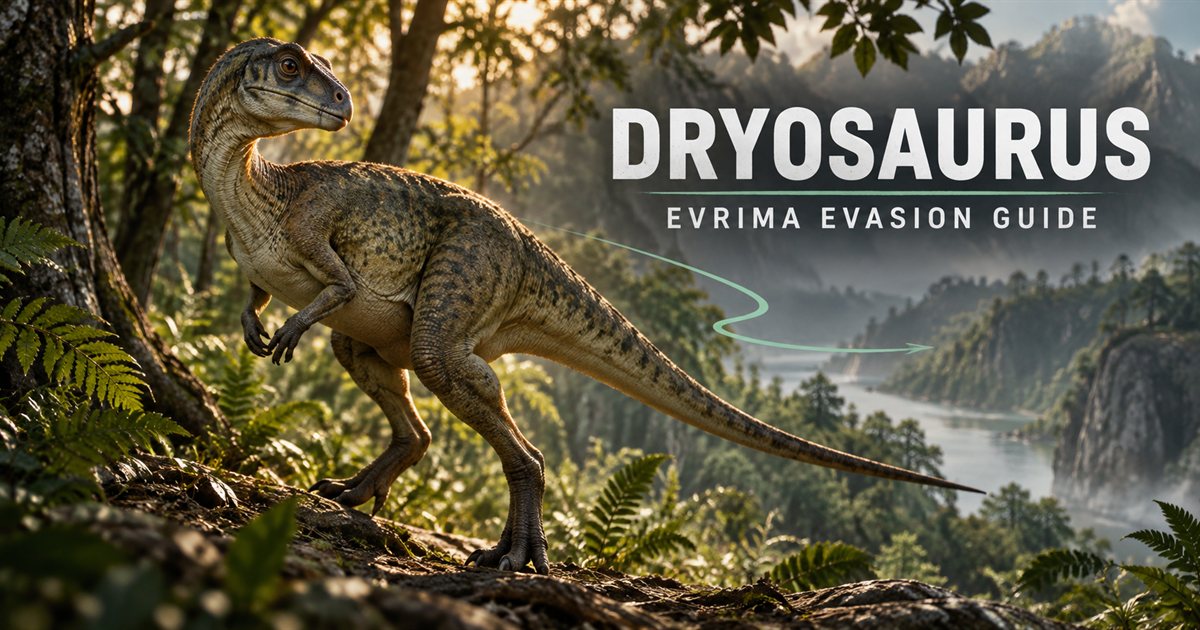
How do you survive as Dryosaurus in The Isle EVRIMA? Give yourself somewhere useful to go before you need to escape. A direction change helps most when it leads toward ground you understand; repeatedly turning without a destination can keep you beside the same threat.
This Dryo guide covers dodge practice, food trips, juvenile decisions and navigation on Gateway. The three AI-generated illustrations show concepts, not actual game screenshots, exact dodge animations or measured routes. The current Controls menu and Status Report take priority over reference lists and older footage.
Dryosaurus controls: learn what changes with camera and movement
The community Dryosaurus reference lists RMB for a camera-directed dodge. It describes different LMB attacks according to movement and camera direction, and notes that carrying food prevents dodging. The site warns that some information is outdated; verify those conditions in your current build.
| Reference input | Listed action | Check in practice |
|---|---|---|
| RMB | Dodge | Compare camera direction and departure direction. |
| LMB, walking forward | Kick | Distinguish it from the running action. |
| LMB, sprinting | Bite | Observe movement before and after the input. |
| LMB, camera to side or rear | Tail attack | Learn how camera placement changes the response. |
The official June 2025 patch notes disabled bleeding on the Dryosaurus directional attack. That historical change is a useful reason to question old combat demonstrations; it is not a current damage chart.
A short practice routine before your first difficult encounter
Choose open, quiet ground with a recognizable rock or tree. Move toward it, turn your camera, perform one action, and stop. Look at where the animal ended up relative to the landmark. Repeat from another direction. You are learning the relationship between input, camera and movement, rather than memorising an animation in isolation.
Next, try a direction change beside a broad obstacle with clear space on both sides. Do not begin inside a narrow gap. The useful question is whether you can choose an exit and reach it without becoming caught on the obstacle. If you cannot explain where you will land, simplify the exercise.
Finally, compare travelling empty-handed with carrying a resource. If your response differs, identify the condition instead of assuming a button failed. Put the food down and reassess before testing again. Keep practice separate from an actual chase so you can notice mistakes without another player deciding the pace.
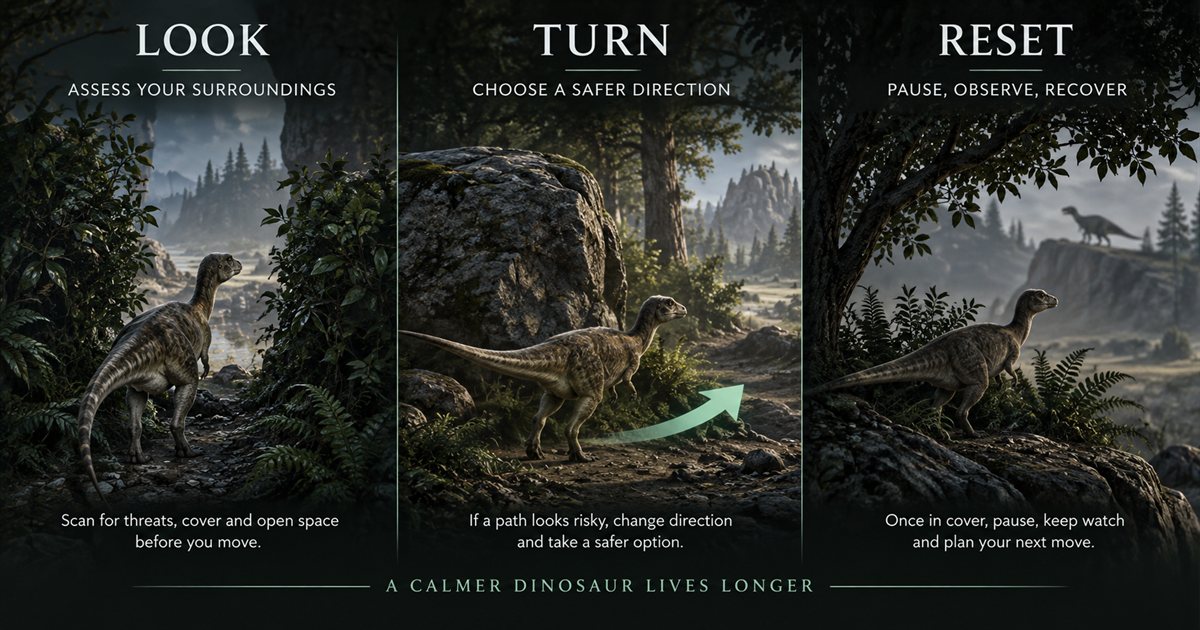
Escape planning: change the situation, not just your heading
When another animal approaches, assess the next stretch of ground early. Is there a clear way out of the feeding spot? Does the route end at water, a steep descent or a dense obstacle you have not tested? Moving before the approach becomes crowded leaves more time to choose.
Avoid making repeated circles around the same landmark your entire plan. A pursuer may keep you in the area while another player approaches from elsewhere. Use a direction change to work toward a different position, then reassess what you can see and hear.
For example, you might be feeding beside a rock with woodland beyond it. First establish whether the woodland has a manageable entrance. If it does, that is a clearer objective than simply running around the rock until something changes. If the gap is too narrow or ends in unfamiliar terrain, choose another departure before the encounter closes.
Cover can break your view as well as somebody else's. Once behind vegetation, keep looking and listening rather than treating the change as proof that the pursuit ended. Do not use a dodge as permission to test a dangerous matchup. This guide recommends practical escape decisions, not guaranteed counters or immunity.
Keep a reserve for the next decision by reading our stamina guide. A long sprint with no destination can leave the resource problem unchanged when you finally stop.
Dryo diet: make a food trip you can explain and repeat
Open the current Status Report and choose the nutrient or food objective before leaving. Compare hunger, thirst and condition. You may need to eat soon, improve a specific nutrient, or recover before travelling; those situations need different priorities.
Pick one resource direction and a return landmark. After feeding, check whether the intended bar changed. If it did not, update the plan from the current panel instead of continuing to eat blindly. Our diet guide explains that distinction in more detail.
Before carrying food away, consider whether carrying changes the movement option you were relying on. A small delivery to a companion should not become a trip through ground where you cannot comfortably respond. Agree on a nearer meeting place when the original plan feels awkward.
Resource markers are references, not a live inventory. Observe the plants and the surrounding ground when you arrive. If the area is crowded, moving to a different resource opportunity may be more useful than repeatedly trying the same approach.
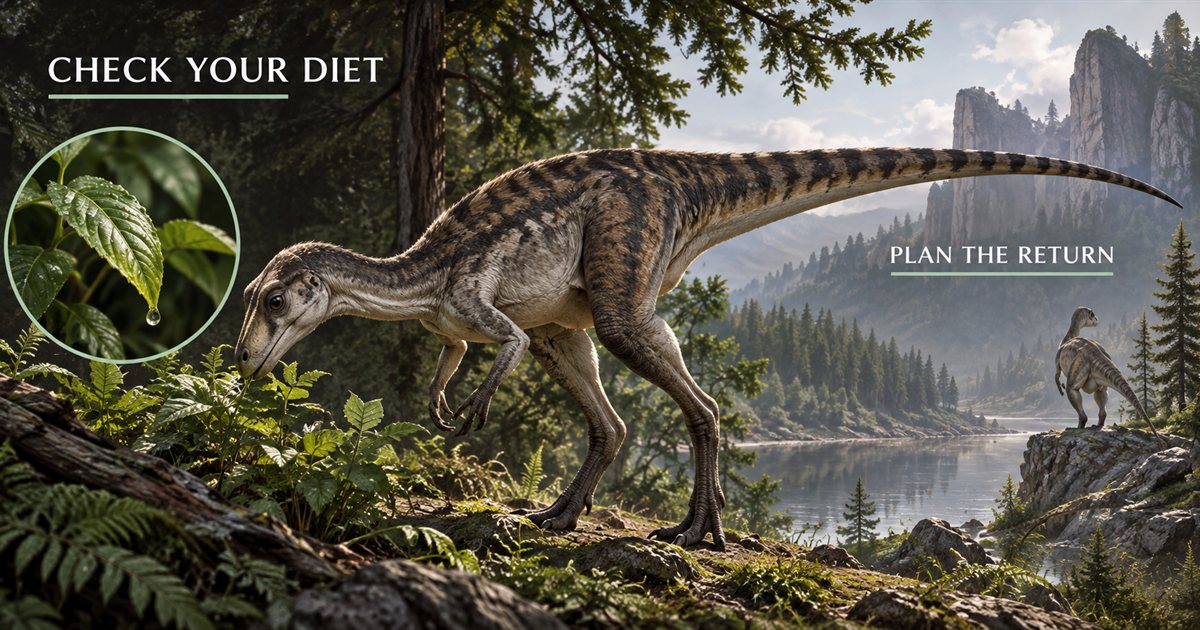
Growing a juvenile Dryosaurus: build local knowledge first
Learn a short loop connecting a familiar feeding area, one water approach and a resting landmark. On the first trip, pay attention to what each landmark looks like from the return direction. That reduces the chance of recognising the destination only when you approach it from one side.
When joining friends, ask them to stop somewhere specific. Continually chasing a companion who is already moving can turn a small rendezvous into an unnecessary crossing of several regions. Refresh both positions and agree which player should travel.
Approach water deliberately; small size and a quiet shoreline do not establish safety. Our water guide and growth guide cover resource and progression decisions without promising one route or growth time.
Can Dryosaurus burrow in EVRIMA? Check the branch before the controls
Do not copy a Legacy burrowing tutorial into an EVRIMA session and assume its instructions apply. Development previews and Hordetest footage also need a branch check. A feature shown in a preview is not automatically available on the public branch you joined.
The official September 2026 DevBlog #73 described new Dryo-related experimentation as development work. It did not establish a released burrowing input. This guide therefore does not tell you to dig a burrow or rely on one as an escape. Read the released patch notes for your branch before treating a new ability as part of your survival plan.
Using TheIsleMinimap to keep a Dryo meeting practical
Enable location names and relevant plant references in Map Layers. Update your position by copying Asset Location or using approved local screen reading while Lat and Long are visible. The marker is your latest accepted coordinate update, not continuous movement while the coordinate panel is hidden.
Squad plans support private app groups of up to four; Solo Lifetime offers local navigation. App squads are separate from The Isle's grouping rules. The app does not read dodge availability, food, stamina or health, detect hidden pursuers, or choose a safe escape path.
Compare the other small herbivore in our Hypsilophodon guide, or the herd-focused play style in our Diabloceratops guide.
Dryosaurus questions
Is dodging a guaranteed escape?
No. Treat it as one movement option and choose a useful destination before spending time beside a threat.
Why does my dodge behave differently while carrying food?
The community reference identifies carrying as a restriction. Check that condition, your bindings and your current build during quiet practice.
Should I follow a fixed diet list?
Use the current food panel and nutrient bars. A reference location helps exploration but does not confirm what is available or what you need next.