
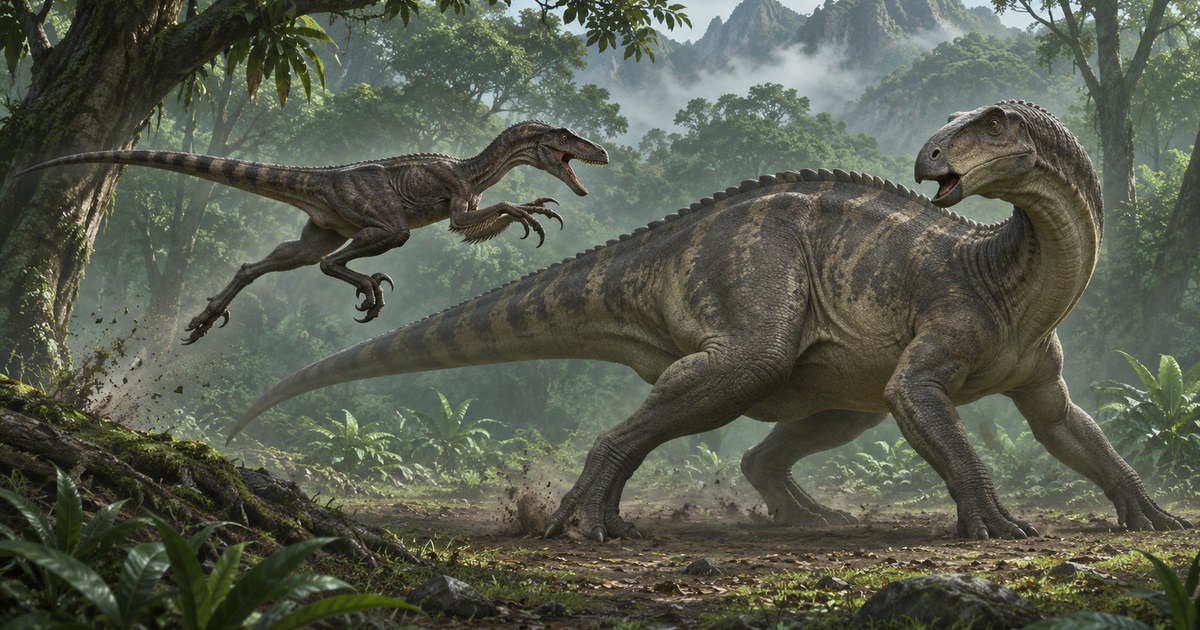
To buck a latched raptor in The Isle EVRIMA, hold your Buck key, normally E. Do not just tap it once. Bucking uses stamina, and it is not an instant escape button. First recognise whether an attacker is riding on your animal or whether you have already been pinned to the ground: those are different situations.
Quick response: hold Buck while latched, watch your stamina and surroundings, and prepare to move away when the attacker dismounts. If you are pinned, do not assume the same input will immediately free you. Check your own Controls menu before relying on the default E binding.
This guide focuses on defending against Omniraptor-style latch attacks in EVRIMA. Troodon venom, other species' grapples and ordinary knockdowns should not all be treated as the same mechanic. The cover is an AI-generated conceptual illustration, not an exact game model, screenshot or animation reference.
How to buck a raptor off your dinosaur
The fan-maintained Evrima Quick Guide combat reference documents holding E to buck latching animals and notes the stamina requirement. Its older timing and weight figures are not a reliable universal timer for the current game. Use the action name in your live Controls menu if you have remapped your keys.
- Identify the latch. An attacker attached to your side or back is different from a raptor simply running beside you.
- Hold Buck. Look for the defensive response where visible, rather than assuming a quick keypress completed the action.
- Watch the rest of the pack. Fixating on the attached animal can hide a second approach.
- Use the dismount to reset. Look toward your exit before deciding whether to attack, reposition or disengage.
Do not spend the whole encounter trying to bite an attacker your animal cannot reach from that position. Your species' attacks and turning options matter. A defensive kick that works for one herbivore is not an ability every dinosaur shares. Our controls guide is a starting reference, while the current game menu remains the place to check your bindings.
Pounce, latch and pin are not interchangeable
A pounce is the attack attempt. A latch is an attacker remaining attached. A grapple can develop into a pin that puts the victim on the ground. Recognising the resulting state is more useful than calling every jump a pounce and expecting the same escape.
The official 2024 update notes introduced a grapple system for Omniraptor. They explain why advice from before that change can miss an important part of the encounter. This historical announcement does not establish a permanent current weight threshold, required number of raptors or guaranteed escape time.
If you are already held on the ground, do not read the opening instructions as a promise that holding E reverses a completed pin. Prevention matters: notice nearby attackers before they can combine their pressure. Avoid committing all your stamina to chasing one raptor while others are circling.
Avoid making the next pounce easy
Choose ground where you can see approaching animals and still turn or leave. This is a balance, not a rule to always run into an open field. Dense vegetation may hide you, but it can also hide the next attacker. A narrow gap may limit approaches while trapping your own movement.
Keep your camera on the encounter rather than staring only at the direction you are running. If a raptor dismounts behind you, immediately chasing it can turn your flank toward another one. Reassess the group before spending more stamina.
Do not use a cliff jump or deep water as a guaranteed removal trick. A fall can kill your own animal; swimming introduces stamina, exit and aquatic-predator risks. A plan that removes one problem by creating a worse one is not a dependable escape route. See the water guide before treating a river as shelter.
Surviving the latch is only half the encounter
Travel sprinting, combat movement and bucking all leave you with less room for the next decision. Preserve a reserve before contact where possible. Do not interpret the first dismount as proof you can now chase safely: the attacker may still have companions and you may have little stamina left.
After creating distance, check your actual condition. A successful dismount does not remove an injury already inflicted. Read the bleeding and healing guide for recovery decisions. Avoid stopping at the exact location where the pack last saw you unless the immediate situation leaves no better option.
With friends, use clear information: which side the attacker is on, whether you can still move, and where you intend to go. “Help me” gives less useful direction than identifying the threat. Coordinate within the game's grouping limits and your server's rules.
What if holding Buck seems to do nothing?
Start with the distinction between an input problem and a combat state you cannot escape that way. A pin, depleted stamina and a normal latch are not equivalent tests. Repeatedly pressing different buttons during a fight will not show which explanation applies.
- Check the binding: confirm Buck is assigned, especially after an update or a customised control setup.
- Check the state: note whether you were upright, latched, knocked down or pinned.
- Check stamina: record whether you had resources when you tried.
- Check input conflicts: if E also triggers another contextual action, test a separate Buck binding in a controlled practice session. This is a diagnostic step, not a guaranteed bug fix.
If it remains inconsistent, a short recording showing the state, stamina and attempted input is more useful for a game bug report than “bucking never works.” Include the game version and server. TheIsleMinimap does not perform bucking or change The Isle's combat inputs.
A short practice checklist
Before your next serious encounter, confirm your key, learn your own species' defensive attacks, and identify what its movement looks like after an attack. If you practise with another player, use a permitted environment and agree to stop before an accidental kill.
For the attacking side, read the Omniraptor guide. For venom-based pouncing, use the separate Troodon guide. Those differences matter more than memorising one supposed counter for every dinosaur that jumps.