
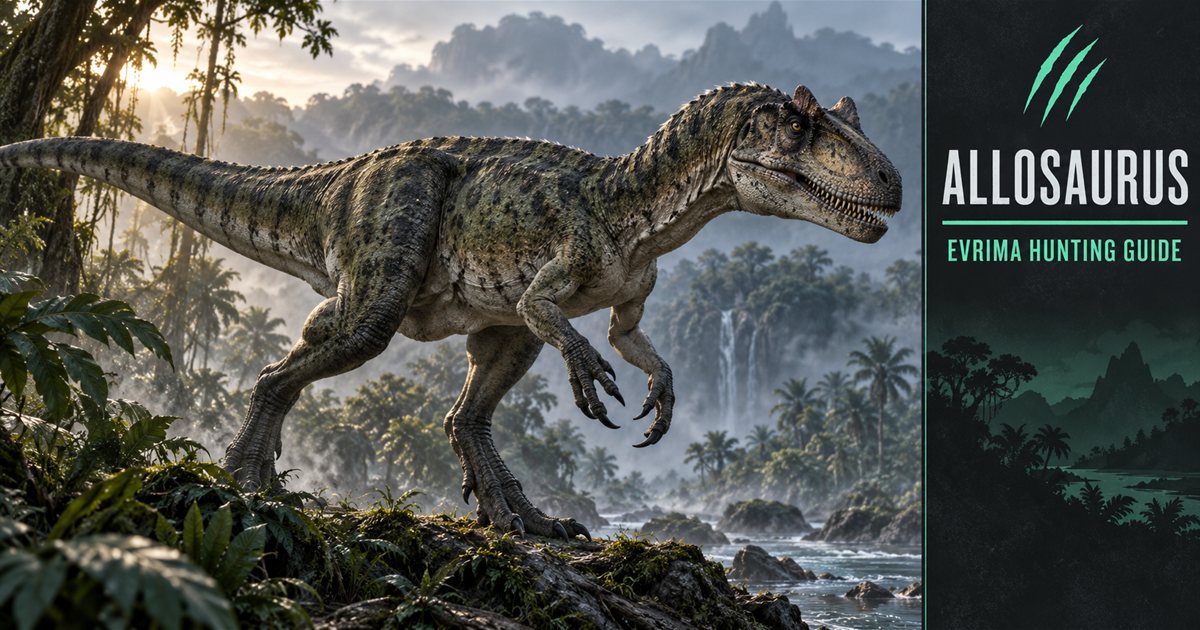
Learning Allosaurus in The Isle EVRIMA? Start by separating its pounce from the running claw swipe. Both belong in a hunting plan, but pressing the right button does not solve a bad approach, an empty stamina reserve or a target surrounded by companions.
This Allosaurus guide covers released EVRIMA ability references, bleeding decisions, diet and Gateway travel. It is not a Legacy Allo tutorial or a fixed combat-stat sheet. Check your current bindings, game prompts and server rules. The four AI-generated illustrations are conceptual teaching scenes, not official screenshots or exact game animations.
Allosaurus controls: claw swipe versus pounce
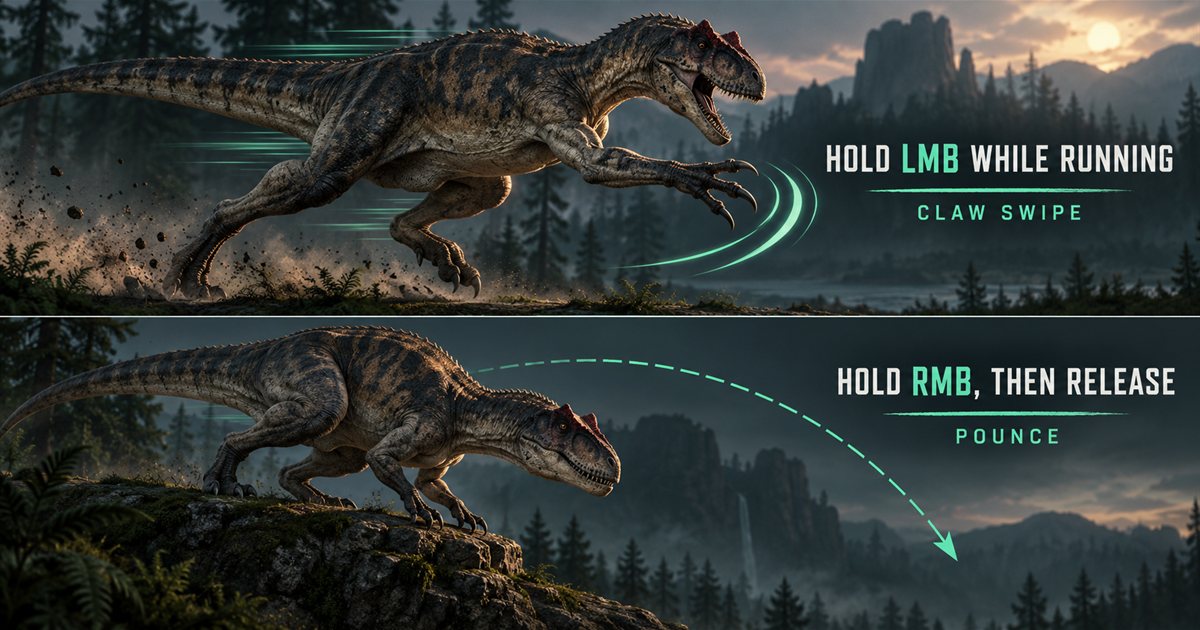
The official patch 0.21.321 release notes describe two distinctive inputs:
- Hold LMB while running: claw swipe, an attack associated with heavy bleeding
- Hold RMB, then release: pounce, which can latch onto a target and apply damage and bleeding
Make the movement condition part of your practice. Test how a quick primary input differs from holding it while running. Then test the preparation and release of the secondary input in open space. Learning which action you are asking for is more useful than repeatedly clicking both buttons when an encounter becomes tense.
Before using pounce against another player, learn the current disengagement prompt and how to respond if the opening disappears. This article does not prescribe a universal release key for every control configuration. Your own live prompts are the reference; do not assume the Omniraptor guide is an interchangeable Allosaurus control sheet.
How to approach an Allosaurus pounce
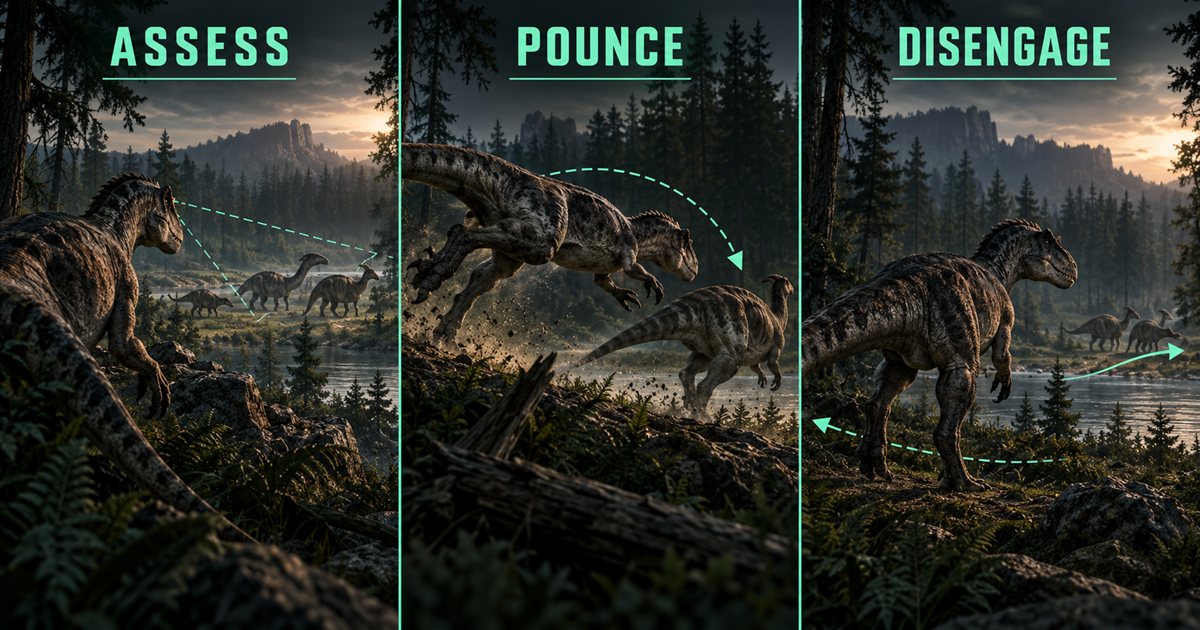
Think in three stages: assess, commit, disengage. Assess the target's direction, nearby animals and the ground around it. Commit only while that opening still exists. Keep evaluating the encounter afterward rather than deciding in advance that every latch should last as long as possible.
A lone animal near open terrain offers a different decision from one beside a tree line with unseen companions. The second situation can become crowded quickly. Before closing distance, identify where you could move if another player arrives or your intended angle disappears.
Do not let the pounce button replace target selection. Large horns, tails, confined terrain and changing orientation all deserve attention. A target facing away when you first spotted it may not remain facing away when you reach it. Compare the encounter you actually have with the one you imagined at the start.
For example, you follow a target toward a steep riverbank. You may still be able to attempt an attack, but a miss or disengagement could leave you beside water with poor footing. Waiting for a better position, or abandoning the attempt, preserves choices that the original approach would remove.
Bleeding: avoid turning pressure into a reckless chase
Bleeding is a reason to reassess an encounter, not proof that the other animal will fall after a fixed number of seconds. Do not infer its remaining condition from one animation or a visual effect alone. You still need to watch its movement, companions and response.
After an attack, look at your own resources before following. Continuing a pursuit through unfamiliar terrain can leave you with no comfortable recovery stop, even if the earlier exchange seemed favourable. Ask whether you can afford the journey back if the target keeps moving.
If you are injured, stop treating the session as only a hunt. Find room to observe and decide whether retreat or recovery is now the priority. The bleeding, healing and fractures guide explains injury decisions without promising a universal recovery timer.
A useful habit is to decide on a reset point before committing: a recognisable landmark away from the encounter, not a magic safe zone. If the fight becomes confused, you have a place to regroup and reassess. Check whether it remains suitable before resting there.
Allosaurus diet and juvenile survival
Read the preferred foods in your current Status Report before choosing a long hunting route. Hunger, diet and travel resources need to be considered together. A meal that fills the stomach may not complete the nutrient balance you were seeking.
After feeding, inspect the live bars rather than relying on the appearance of the food. Our EVRIMA food and diet guide covers the broader system. Keep a second resource option in mind if the first location is empty or contested.
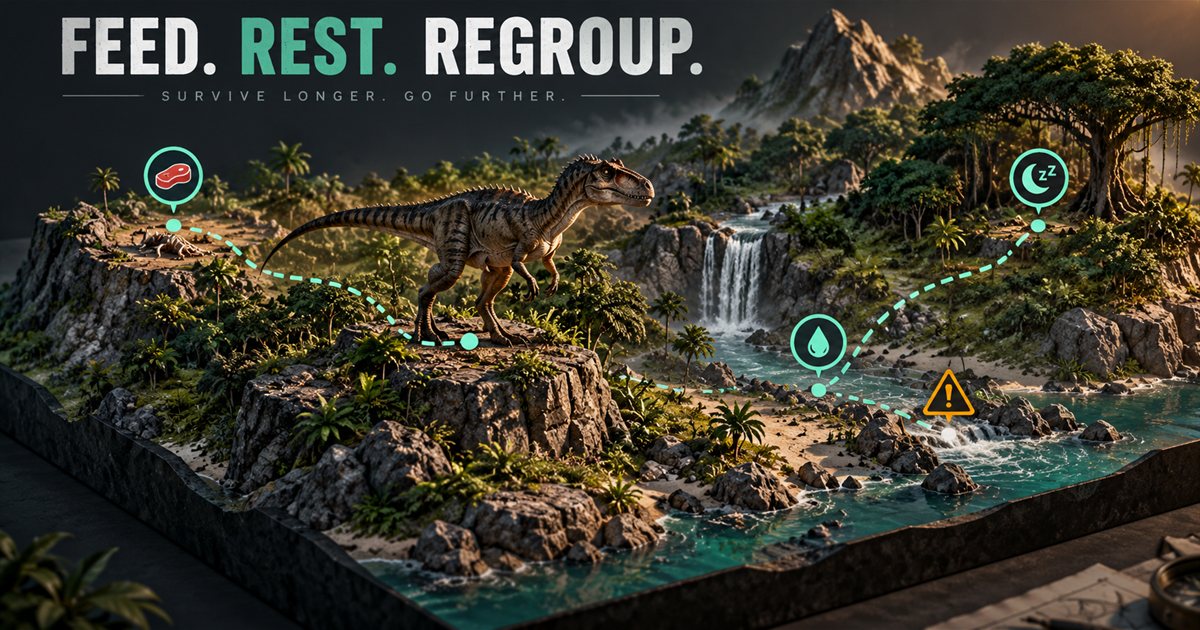
For a juvenile Allosaurus, begin with a manageable local loop. Locate yourself, identify water, look for a realistic food opportunity and learn a return landmark. Avoid trying to copy an adult's successful fight before you understand what your current animal can do.
Do not spend the entire opening sprinting between distant destinations. Arriving exhausted can make an otherwise ordinary resource visit difficult. Compare your current needs before taking a detour, and use the stamina guide for recovery planning.
This guide does not give a fixed Allosaurus growth timer or a guaranteed prey list for every patch. Your live animal panel is the reference. The AI spawns guide also explains why a marked reference location is not confirmation that a live animal will be waiting.
Gateway travel and hunting with friends
Agree on a meeting landmark before splitting up. A description such as the dry side of a known river approach is more useful than telling a friend to follow a call into unfamiliar terrain. Refresh both positions before making a long journey toward each other.
Leave room between your movements during an encounter. Several players rushing the same opening can make the situation harder to read, not easier. Decide who is watching the surroundings and when to stop chasing. Communication is an advantage only when it leads to clearer decisions.
When an encounter ends, solve the next resource need before beginning another. Repeatedly starting new hunts while water or recovery is overdue can turn a promising run into an avoidable emergency. The water guide gives context for evaluating river approaches.
Compare a direct map line with the terrain you can see. Do not force a river crossing, narrow passage or steep descent simply because it looks shorter. Navigation should help you recognise alternatives, not persuade you to ignore the ground.
Using TheIsleMinimap as Allosaurus
Enable useful location names and resource references in map layers. Copy Asset Location in-game or use your enabled screen reader with its approved area while Lat and Long are visible. Your marker reflects the latest accepted reading; a hidden coordinate panel does not provide new positions. See the coordinate setup guide.
Squad plans support private app squads of up to four players. They are separate from The Isle's in-game grouping rules. Solo Lifetime is for solo use. Always follow your official or community server's rules regardless of the app squad size.
Allosaurus questions
How do you pounce as Allosaurus in EVRIMA?
Prepare with held RMB and release, following your current bindings and game prompts. Learn disengagement before committing to a player encounter.
Why is my running claw swipe different from a normal click?
The released reference gives claw swipe a held primary input while running. Check both the held input and movement condition when practising.
Does bleeding guarantee a kill?
No. Keep observing the encounter and manage your own condition. A visual effect is not a reliable countdown to another player's death.
Should I play Allosaurus or T-Rex?
Compare the decisions you want to learn. This guide focuses on pounce and claw-swipe approaches; the T-Rex guide covers Crush, muzzle swings and Ambush. Neither choice guarantees winning fights.